
We have a new food guide put out by the USDA and HHS. Some think it’s controversial. Some think it’s better than sliced bread (pun intended). I do see it fills a need in our current time while lacking in other areas. The overall focus is to eat real foods. The USDA food guides have been around for over 100 years now and every food guide put out has had an intended purpose for the generation it’s meant to serve.
Let’s get into the history of our food guides throughout the years and see what their goals were to understand why we have the one we do now.
1916 and 1917
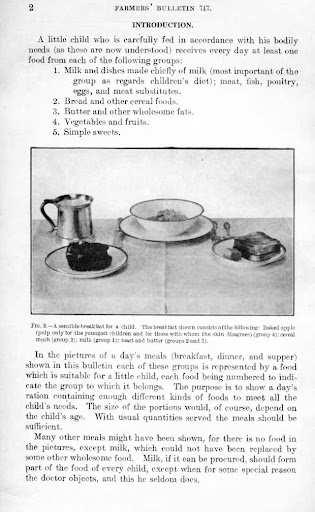
The goal of the food guides, when they first came out in 1916, was geared toward children. They wanted to ensure that kids were nutritionally sound based on the latest science.
The guide in 1916 was called “Food for Young Children”. Food was divided into 5 different categories being milk based dishes, bread and cereals, butter or wholesome fats, vegetables and fruits, and lastly simple sweets.
Then came the “How to Select Foods” in 1917 to help support conservation of foods during World War 1. It offered suggestions on alternatives when food was scarce so children had well-balanced meals regardless of what was on the shelves. People were also trying to living budget conscious at the time.
Based on these guides, there was a lot of at-home processing going on and breads were considered almost a complete food at the time which I found interesting. More to come on that in a future blog.
1940’s
The next prominent food guide was “The Basic 7 Food Groups” and came with cute slogans like, “Eat a lunch that packs a punch!” These marketing campaigns were clearly driven towards the World War II efforts in keeping a healthy and strong population.
Suggestions were made to heavily promote protein options outside of meat with it being rationed in the war. This means that dairy products, beans, or peanut butter was suggested as an alternative. Potatoes are also in because they were easy to come by. You will also notice that whole grains became a new phrase. They realized that stripping bread of its wheat germ, while making it shelf stable, made it nutritionally dead. “Enriched” bread was the new bread. This means they made efforts to put back in the vitamins and nutrients.
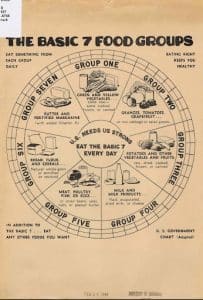
Instead of the five groups previously seen, there were now seven categories.
These categories are
- Green and yellow vegetables
- Oranges, tomatoes, and grapefruit
- Potatoes and other veggies/fruits
- Milk and milk products
- Meat, poultry, fish, and eggs
- Bread, flours, and cereals
- Butter and margarine
Again, these suggestions were based on the latest nutrition science and what the needs of the population were. While the categories appear random in selection, they are instead categorized based on specific vitamin and nutrient needs.
The vitamins and nutrients are
- Vitamin A
- Vitamin C
- Fiber and Carbs
- Calcium and Protein
- Protein
- Whole Grains
- Vitamin A and Fat
1956
For the next phase of USDA recommendations, things became simple with “Food for Fitness: A Daily Food Guide”. They went down from seven categories to four groups.
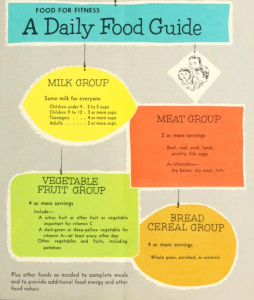
The four groups were
- Milk Group
- Meat Group
- Vegetable Fruit Group
- Bread Group
They offered bare minimum serving sizes per group to ensure nutritional needs were met. Fats, sugar, or calorie intake was not addressed. Also note, potatoes and meat are still in and breads still have their own category.
1979 and Diet Culture Begins
This really was the beginning of diet culture and efforts to combat chronic disease. Each food model from here on out will be based on the latest diet and chronic disease research.
In 1979, moderation of fats, sweets, and alcohol were added to the previous basic four model, creating five groups.
In 1984, calorie levels were added with continued moderation suggestions for fats and sweets. Note the size of the grains, cereals, and breads slice.
World-wide, obesity tripled from 1975 to 2016. Interestingly enough, the Atkins diet began taking off around this same time. It was actually contradictory to the food advice put out by the USDA. It promoted high protein intake and healthy fats while moving away from carbs.
Pyramids of 1992 and 2005
The food pyramid took its first shape. Grains made up the base of the pyramid, suggesting the largest portion size. Then fats, oils, and sugars made up the smallest portion at the peak.
In 2005, moderation and variety were still suggested with the pyramid shape. This model really pushed for calorie tracking and movement. A character was placed on the side of the pyramid as a new twist to emphasize the benefits of movement. This was groundbreaking. Adults were asked to get 30 mins of moderate daily exercise. Teens and kids were asked to get 60 mins of moderate exercise.
MyPlate of 2011
The visualization changed from a pyramid to a plate for a simple visualization. While still broken up into portions of fats, proteins, fruits, veggies, and dairy, it offered portion suggestions based on the size of the cut outs. This was to make it less confusing.
Suggestions were made to move away from trans fats, sugary drinks, and red meat based on the latest science. There were also comments to avoid potatoes as a vegetable. Potatoes are now officially out.
2026 Pyramid is Upside Down
The marketing for this pyramid turned the whole thing on its head, literally. Grains are still the base of the pyramid but now they are the smallest portion. The largest portion is now proteins and vegetables, listing healthy fats and fruits as secondary. Also, hello, red meat is back in. It closely resembles the Atkins Diet that took off decades ago.
This pyramid offers a protein target of 1.2 - 1.6g of protein per kilogram of body weight per day to support a healthy body. It is also the first of its kind to suggest moving away from processed food.
While I like most of the food suggestions, I will say that I would change a number of things. It’s important to note that food suggestions have always been influenced by political pressure and lobbyists.
See you in the next blog with what I would change about this current pyramid.
See the latest food pyramid suggestions here
If you want to follow along in the facebook community page, join here.